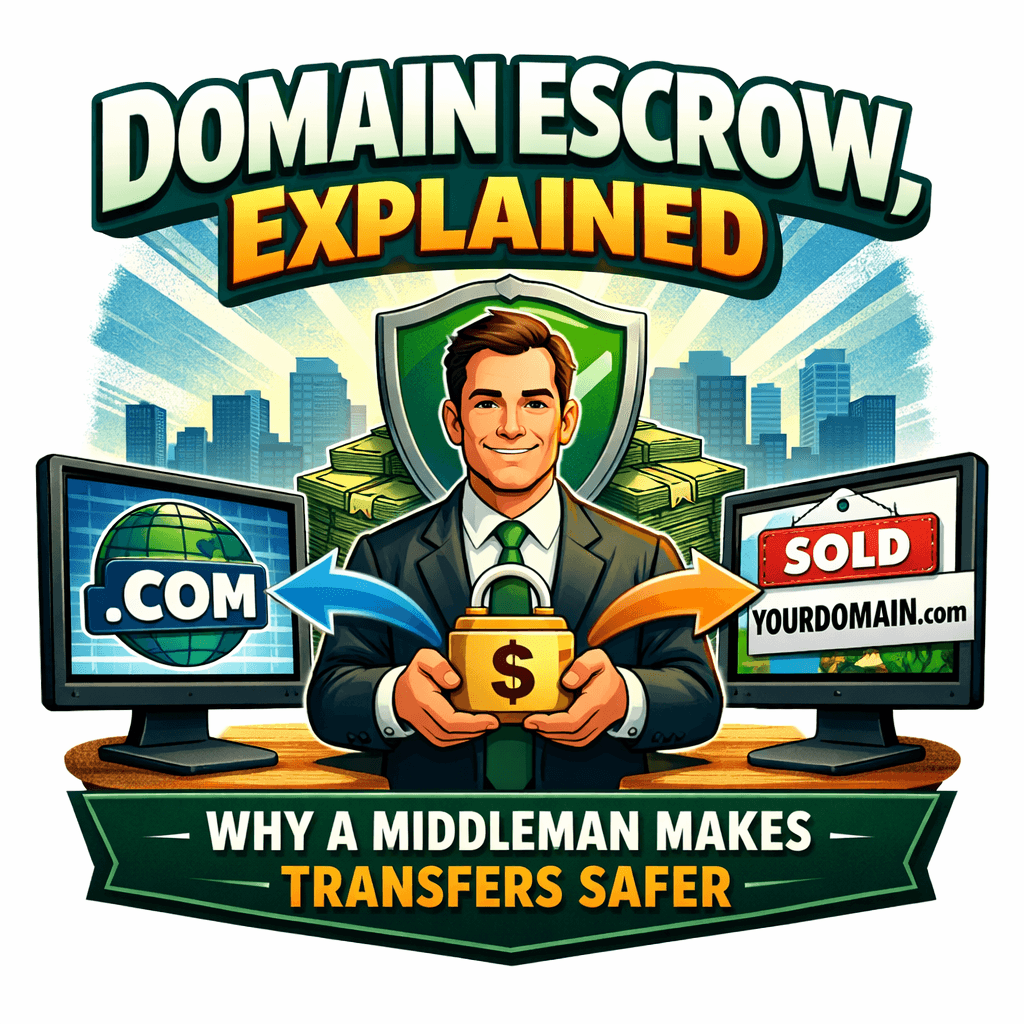
Here’s the awkward truth about buying a domain name from a stranger on the internet: neither of you has any reason to trust the other. The buyer is being asked to wire thousands of dollars to someone they’ve never met, on the promise that a domain name will be handed over afterwards. The seller is being asked to hand over the domain — an asset that, once transferred, is essentially gone — on the promise that the money will follow.
That’s not a comfortable trade for either side. Escrow exists so neither party has to take that leap of faith.
What escrow actually does
A domain escrow service is a neutral third party that holds the money while the transfer happens. The choreography is always the same:
- Buyer and seller agree on a price.
- Buyer wires the funds to the escrow service. The escrow service confirms receipt.
- Seller pushes the domain to the buyer’s registrar account (or initiates a transfer with an auth code — we’ll get to that).
- Buyer verifies they control the domain.
- Escrow releases the funds to the seller, minus the service fee.
If anything goes wrong — the seller never transfers, the buyer never funds, the domain doesn’t match what was advertised — the escrow service is the arbiter. Funds don’t move until both conditions are met: money in, domain out.
This is a structurally different trust model than “send me the money and I’ll send you the domain.” The escrow service doesn’t need to trust either of you. You don’t need to trust each other. You both trust a known, licensed entity whose whole business model depends on being trustworthy.
Why not just use a wire transfer?
People ask this a lot, especially for smaller deals where the escrow fee starts to feel meaningful. The honest answer is: wire transfers work fine if you know and trust the counterparty. They fail catastrophically when one party is acting in bad faith.
A short list of failure modes a wire transfer exposes you to:
- Seller takes the money and disappears. Rare but not unheard of, especially for deals struck outside of an established marketplace.
- Seller transfers the domain, buyer claims non-receipt and reverses the wire. Wire reversals are hard but not impossible, particularly across jurisdictions. Meanwhile the domain is gone.
- Seller doesn’t actually own the domain they’re selling. This is a surprisingly common scam on lightly-moderated forums. The “seller” has scraped public WHOIS data and is selling a name they have no control over.
- Registrar disputes. If the transfer itself goes sideways (wrong account, locked domain, auth code mismatch) you end up in a three-way dispute with no neutral party to break the tie.
Escrow defuses all of these. It’s not a hypothetical safety net — the fee is the insurance premium, and the service is the insurance.
The fee: what it is, and what it’s actually covering
Escrow.com is the dominant provider for domain transactions and most marketplaces route through them. Their fee schedule is tiered, typically running 0.89% to 3.25% depending on transaction size and payment method. A $5,000 deal costs roughly $50-$150 in escrow fees.
That’s not free. But consider what the fee buys you:
- KYC/AML compliance on both sides. Escrow.com verifies the identities of both parties. This alone is a meaningful fraud filter.
- Payment-method handling. Credit cards, bank wires, PayPal, crypto in some regions — escrow services manage the settlement headaches so you don’t have to.
- Chargeback protection. Once the deal is closed and funds released, the seller is protected from a buyer who later files a chargeback.
- Dispute resolution. If the domain doesn’t match what was advertised or the transfer fails, there’s a formal process to adjudicate rather than a messy email chain.
- A legal paper trail. If anything goes to court later, the escrow record is clean evidence of the transaction.
Most serious buyers of $1,000+ domains pay the escrow fee without negotiating it. The cost of an unescrowed deal going wrong at that price point is an order of magnitude larger than the fee itself.
What the buyer should verify
Before funding the escrow, a disciplined buyer checks a few things:
- The seller has admin access to the domain — confirmed by asking them to make a small, reversible change (a DNS TXT record, a contact email) that you can verify from the outside.
- The domain isn’t under a transfer lock that would block the handover. Most registrars lock domains for 60 days after registration or transfer; if the seller recently acquired it, you may need to wait.
- The WHOIS record matches the seller’s identity or was plausibly changed recently. A mismatch with no story isn’t necessarily a scam, but it warrants a conversation.
- There are no outstanding trademark disputes on the name. A UDRP filing in flight is a serious problem that changes hands with the domain.
What the seller should do
On the seller side, the discipline is simpler but still matters:
- Respond to the escrow milestones promptly. Escrow services have deadlines; missing them can abort the transaction and force everyone to restart.
- Use a push (same-registrar transfer) when possible. It’s faster, doesn’t require unlocking the domain, and has fewer failure points than a registrar-to-registrar transfer with an auth code.
- Don’t share the auth code until the escrow is funded. The escrow service will confirm receipt; wait for that confirmation.
- Document what you’re selling. If the domain comes with a website, analytics access, an email address, or anything else, spell it out in the listing before the deal closes.
How Deepnom handles this
Every transaction on Deepnom that moves money routes through Escrow.com. We don’t hold funds ourselves, we don’t process card details, and we don’t take custody of domains. What we do is coordinate the negotiation — offers, counters, messaging, signatures — and then hand the closed deal off to escrow for settlement.
That separation matters. A marketplace that holds your money is a marketplace that can fail, get acquired, change policies, or freeze an account without warning. A marketplace that only handles the conversation can’t take your money because it never touches it. Your funds live at Escrow.com during the transfer; your domain lives at your registrar until the moment of handover. Deepnom is the connective tissue.
A quick glossary
Milestone. A stage of the escrow process — agreement, payment, inspection, transfer, release. Each milestone has a status and a deadline.
Inspection period. The time after transfer during which the buyer can verify they have what was promised. Usually 1-2 days for domains. If the buyer accepts or the period expires silently, funds release.
Chargeback. A reversed payment initiated by the buyer’s bank. The reason escrow exists — once funds are released to the seller, a later chargeback is the escrow service’s problem, not the seller’s.
KYC. “Know Your Customer” — identity verification that legitimate financial intermediaries are legally required to perform on both sides of a transaction.
The takeaway
Escrow isn’t a nice-to-have for stranger-to-stranger deals; it’s the mechanism that makes those deals possible. The fee buys trust, compliance, dispute resolution, and a legal paper trail — and the math works out heavily in your favor on anything over a few hundred dollars.
If you’re buying a domain and the seller pushes back on using escrow, that pushback is the story. Listen to it, ask why, and decide accordingly. Most of the time, the honest answer is “I’m comfortable wiring directly.” Sometimes it isn’t.